I have to stop buying those indie games that get rave reviews from “New Games Journalism” sites and are promoted on the front page of Steam and included in “mid-week madness” packages. I mean, I like indie games, and I like the idea of a cottage industry of game designers who risk everything on a crazy idea that no major studio (except Valve) would touch with a ten-foot pole simply because they have nothing to lose anyway, but seriously, you may think of yourself as the next Peter Molyneux or John Romero or Gabe Newell or David Cage, but you see, Molyneux, Romero, Newell and Cage know something you still haven’t learned: it doesn’t matter how innovative your game is, it still has to be playable. Continue reading “I’m so indie, only I can understand my art”
Category: English
Mind the Gap
I don’t get it.
I’ve started reading Stephen Donaldson’s Gap cycle, and I don’t get what’s so great about it.
I don’t mind that the characters are dicks. That’s Donaldson’s thing, and I knew it before I started reading.
I do mind his writing style, which I find flat and unengaging, but I guess it’s a matter of taste.
There are two things, however, that really bother me: plot holes and bad science. Continue reading “Mind the Gap”
chkdsk considered harmful
This list of sysadmin horror stories reminded me of a story of my own:
A long, long time ago, possibly as much as fifteen years ago, I wrote a boot loader of which I’m still quite proud, even though I’ve long since lost the code. I also wrote an installer for it, naturally. The binary was very small (a few kilobytes), even though it included a command-line interface, a partitioning tool, a screen saver and a game, so instead of installing it in a separate partition, I simply installed it in the space between the MBR and the first partition, which on a DOS system in those days was on the order of 30 kB for completely idiotic reasons.
At some point during the development, inevitably, either due to a bug in the installer or incorrect command-line parameters, I managed to install the loader on top of the FAT on one of my DOS partitions. Continue reading “chkdsk considered harmful”
Winter
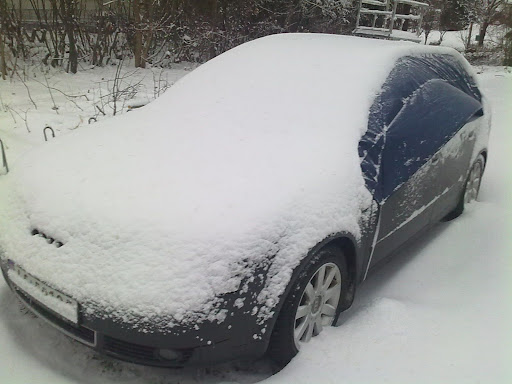
Now is the winter of my discontent with having to park outside four nights out of seven.
On the bright side… quattro :-)
Toys
I am currently contracting for a company that makes lots of nifty toys. It has several siblings which make even niftier toys—the kind that go “boom”. They’re having a show-and-tell today for a lot of people with nice suits and fat wallets, and they’ve pulled all the stops (short of actually demonstrating the equipment) to impress them. Here is some of the stuff they were showing off: Continue reading “Toys”